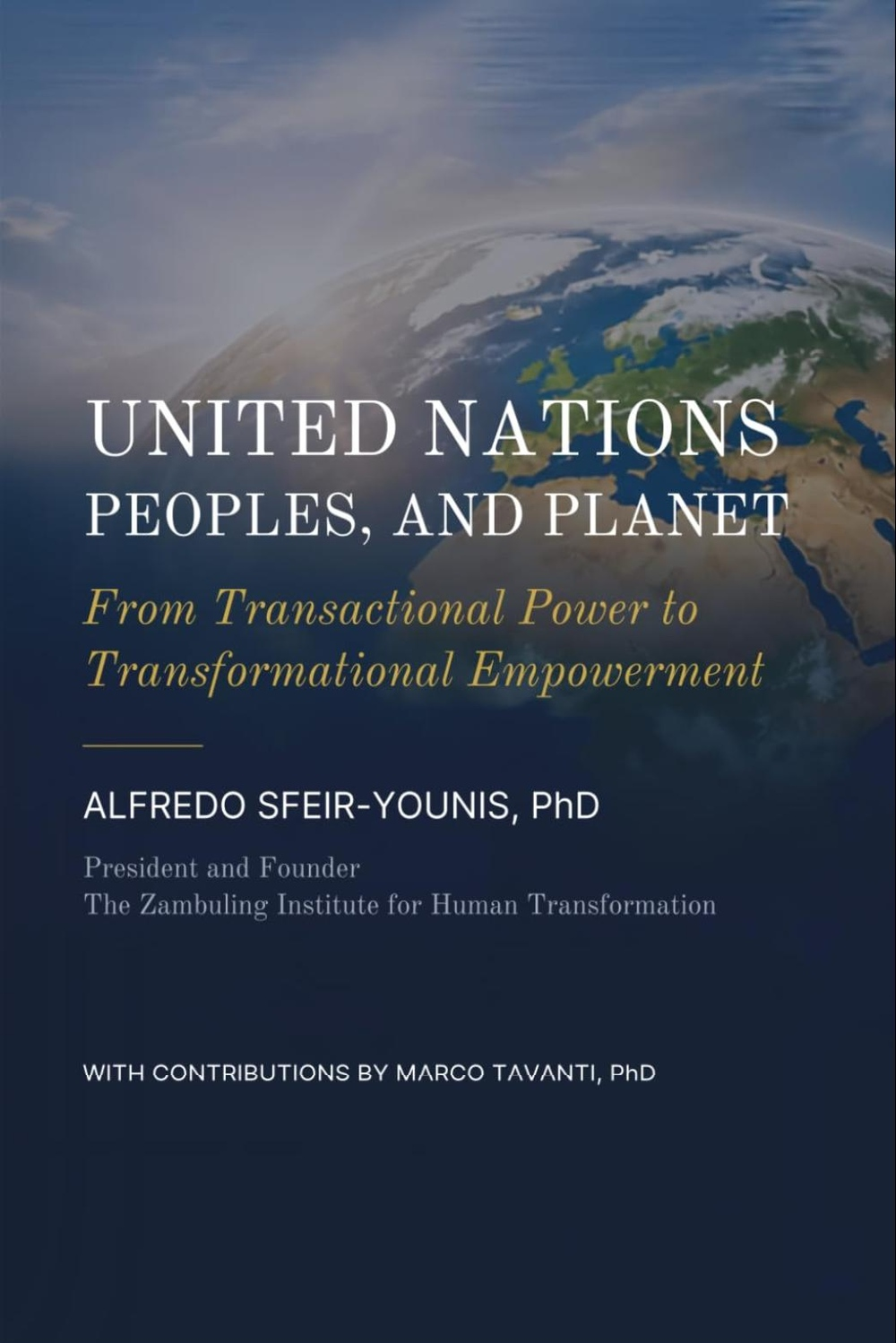
United Nations, Peoples, and Planet
From Transactional Power to Transformational Empowerment
with Contributions by Marco Tavanti, PhD
“The United Nations can continue to manage the consequences of an unsustainable world—or it can help humanity outgrow it.”
From managing power to empowering transformation
For eight decades, the United Nations has been asked to hold together a world divided by competing interests. This book argues that the institution now faces a deeper crisis than budgets or vetoes: a crisis of purpose.
Dr. Sfeir-Younis draws a clear line between two ways of governing the world. Transactional governance manages interests, negotiates compromises, and measures success in budget cycles. Transformative governance asks what kind of world we intend to build together, and places rights, dignity, and planetary co-responsibility at the center.
“One may even say that the UN does not have a financial crisis, but an identity crisis.”
The arithmetic of our priorities
The book confronts the numbers directly:
- $2.7 trillionin global military spending in 2024, 750 times the UN’s regular budget.
- < 2.5%Fully funding the entire UN system would cost less than 2.5 percent of what the world spent on weapons that same year.
- < 1 weekResolving the UN’s financial crisis, arrears included, would cost less than one week of U.S. defense spending.
“This is not a burden. This is the best investment in peace and the prevention of war that the world has ever been offered.”
A complete blueprint for renewal
The book does not stop at diagnosis. It proposes a structural and ethical transformation of the United Nations, built on four pillars:
Financial independence
A shift from country-based contributions to Bretton Woods-based financing, so that the institution charged with preventing war is no longer held hostage by its own members.
The democratization of peace
Peace as the shared responsibility of every nation, every community, and every individual, not the privilege of those with power.
A People’s Council
A voice for the peoples of the world within the architecture of global governance.
The Human Transformation Goals (HTGs)
Eleven goals that complement the Sustainable Development Goals, grounded in one conviction:
“Sustainable development depends not only on what humanity builds (SDGs), but on who humanity becomes (HTGs).”
The instruments of change
Beyond principles, the book delivers the working documents of reform:
- The Ethics Charter for Global Governance
- The Charter of the United Nations, Peoples, and Planet
- The Manifesto of the New UN Secretary-General
- The First 100 Days — a concrete plan of action for the next leadership of the UN
Inside the book
The Diagnosis
- Re-Imagining Multilateralism
- Our Shared Destiny
- Our Collective Ethical Awakening
The Case for the Institution
- Making the Case for the UN
- The UN is Indispensable to the USA
- Compelling Issues for the Next Secretary-General
Financing and Peace
- From Country to Bretton Woods-Based Financing
- The Democratization of World Peace
- A Non-Violent Approach to Peace
Human Transformation
- The Human Transformation Goals (HTGs)
The Strategic Program
- Parts I, II and III
Values and Ethics
- Foundational Values and Guiding Principles
- Transformational Commitments
- Ethics, Economics, Spirituality, and Global Governance
- The Ethics Charter for Global Governance
Instruments and Execution
- The Charter of the United Nations, Peoples, and Planet
- Manifesto of the New UN Secretary-General
- The First 100 Days
- The Future of the United Nations
Leadership at the United Nations: From Transactional to Transformational
Marco Tavanti, Professor of Leadership & Sustainability at the University of San Francisco, contributed to United Nations, Peoples, and Planet and reflects on the book in this article.
Writing from San Francisco, where the UN Charter was signed in 1945, he recalls meeting Dr. Sfeir-Younis at the United Nations in New York in 2005, and traces two decades of shared work on sustainability, Indigenous rights, and multilateral leadership.
He reads the book in four movements: making the case, proposing an architecture, naming the values, and getting operational. What sets it apart, he argues, is that it does not stop at a vision of reform, but specifies what the next Secretary-General should do in the first hundred days.
“They are the ones who will inherit whatever we decide multilateralism is worth.”
In the author’s words
“Peace cannot remain the responsibility of a few, nor the privilege of those with power. Peace must be democratized.”
“The UN was not created to manage a balance of power. It was created to place rights at the center of international life.”
“Institutions cannot rise above the consciousness that animates them. If the UN is to have a future worthy of its founding vision, it must reclaim its soul.”
“Multilateralism is not something the Secretary-General does to member states; it is something we do together.”
“War is the failure of humanity. Peace must be built through diplomacy, justice, and cooperation.”
“We vow to protect Life in all its forms—not as resources, but as relatives.”
For those who shape, study, and believe in multilateralism
Diplomats and delegates to the United Nations. Policy-makers and public officials. Scholars of international relations, development, and global governance. Civil society leaders. And every citizen who believes the world’s only universal institution can still fulfill its original promise.
Get the book on Amazon (opens in a new tab)“If the United Nations embraces this deeper calling, it can still fulfill its original promise of not merely to prevent war, but to help humanity remember who it is and who it is capable of becoming.”